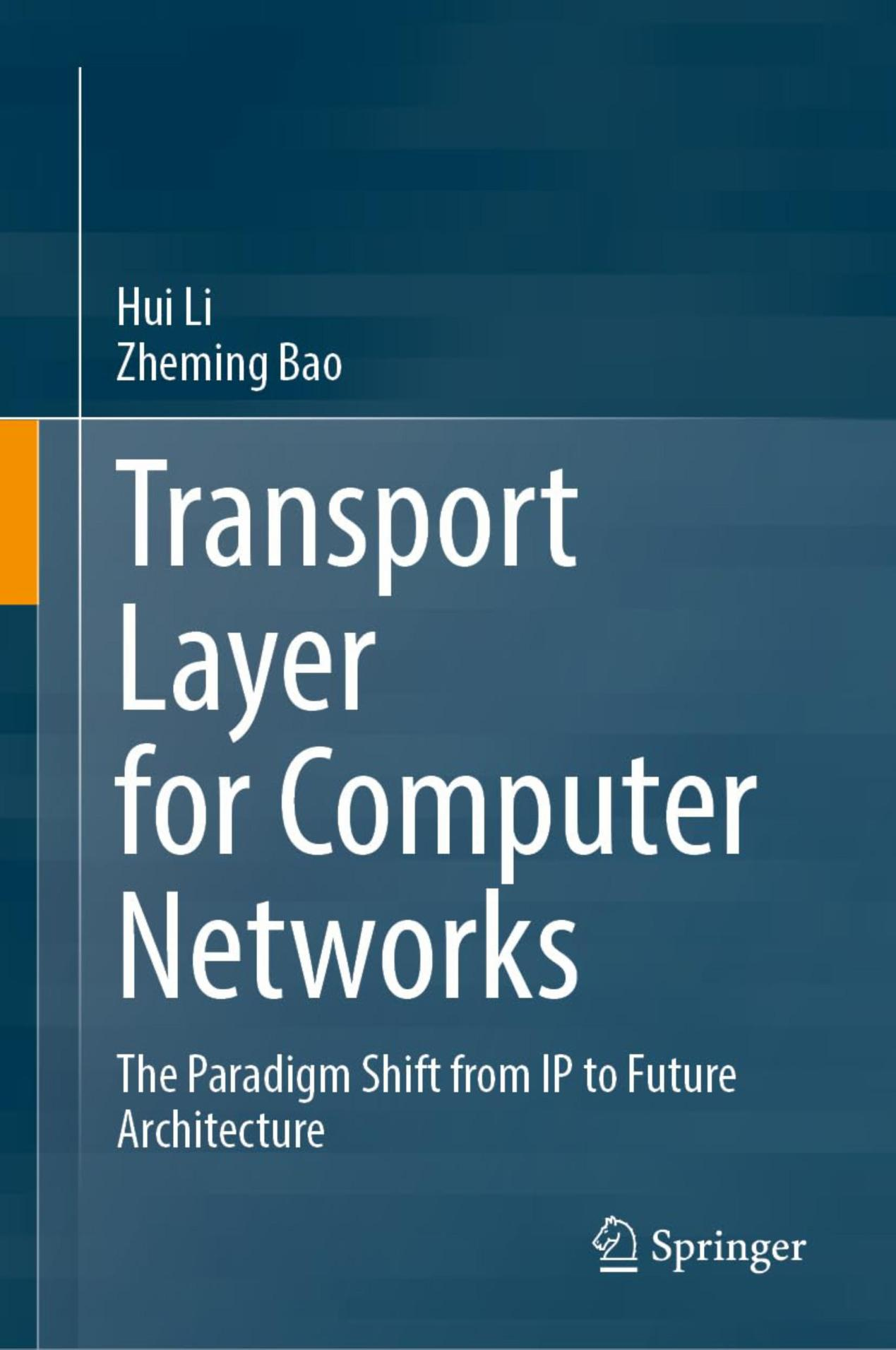
Recently, an English academic textbook titledTransport Layer for Computer Networks:The Paradigm Shift from IP to Future Architecture, co-authored by Prof. Hui Li and his graduate student Zheming Bao, was officially published in open access by Springer Nature. The full text is now freely available to readers worldwide at https://link.springer.com/book/10.1007/978-981-95-7374-5, with a printed edition also available for purchase. This publication marks another significantcontribution by Chinese scholars in the fieldof computer network transport layer and future network architectures. It is the fifth volume in a series of ten Englishmonographesoutlining the Multi-Identifier Network (MIN) framework proposed by Prof. Li.
This textbook systematically elaborates on the evolving role of the transport layer in the transition from the traditional IP architecture to future network paradigms. It providesin-depth analysis of both classical and emerging transport protocols, including TCP, UDP, and QUIC, and proposestechnical solutions and engineering methodologies for building high-performance,highly secure transport systems. These solutions are tailored to emerging scenarios such as 5G networks, computing networks, data centers, and co-governed network environments.
Prof. Li points out thatalthough the TCP/IP architecture is one of the greatest technological inventions of the 20th century and has significantly propelled humanity into the information age, it suffers from three fundamental "design limitations" in terms of sovereignty governance, intrinsic security, and evolutionary capability:
(A) Cyberspace sovereignty in IP-based networks isunilaterallyunilaterally,;
(B) The lack of intrinsic security makes it difficult to prevent security incidents and protect privacy effectively,rendering it the "fifth domain of warfare".
(C) The protocol stack is rigid, resulting in long upgrade cycles and high costs.
The MIN research teampropose a theoretical framework analogous to "Newton’s Three Laws" for cyberspace security:
Law 1 (LawofInertia): Insecurity is an inherent property of IP networks.In other words, deterministic securitysolutioncannot be achieved through purely technical means.
Law 2 (Law pfAction–Reaction): Taking the IP securitycoefficientas 1, futurenetworkarch.admits deterministic technical solutions that can achieve exponentiallycoefficientof10^15-10^20 MIN is oneofsuch solutions.
Law 3 (Law ofAcceleration): Future cyberspace requires the integration of technology, management, and effective legal frameworks to ensure long-term security and stability. Any abnormal state will be rapidly restored to normal under strong multidimensional forces.
A high-level popular science article on this framework was also published in the Chinese edition ofIEEE Spectrum("Science & Technology Review", December 2025).
As an integral component of Prof. Li’s research on future network systems, this textbook is closely aligned with the Co-Governed Multi-Identifier Network (CoG-MIN) architecture. Centered on a "multi-identifier system + multi-identifier routers", CoG-MIN aims to establish a next-generation network foundation characterized by multi-stakeholder governance, intrinsic security, and sustainable evolution.
In terms of content organization, the textbook balances theoretical rigor with engineering practicality. It systematically covers core mechanisms such as connection management, flow control, congestion control, and reliable transmission, while incorporating enterprise-level deployment case studies. Each chapter is supplemented with packet capture experiments, code implementations, and performance evaluations, forming an integrated "theory–protocol–application" knowledge system with both academic and practical value.
The textbook includes a foreword by an academician of the Chinese Academy of Engineering, who highly commends the research team’s systematic innovations in future networking and transport protocols. The related research has already generated a broad impact in both academia and industry, continuously advancingcontributions in network architecture and transport protocols.
At present, the CoG-MIN project led by Prof. Li has established joint "sovereign and trustworthy Internet" laboratories with several major state-owned telecommunications operators and has carried out cross-border deployment validation. These efforts are actively promoting the transition of network technologies from a "China solution" to "global application". The team’s achievements have received multiple international honors, including theuniqueDiamond Award at the 2022 British International Invention Exhibition, the Special Award at the 2024 Canadian International Invention Exhibition, the Special Award at the Macao Belt and Road International Invention Exhibition, and the Leading Scientific and Technological Achievement Award at the World Internet Conference.
Open-access link: [https://link.springer.com/book/10.1007/978-981-95-7374-5](https://link.springer.com/book/10.1007/978-981-95-7374-5)