On February 18, 2026, the research paper “Integrated photonics enabling ultra-wideband fibre–wireless communication” was published online in the top international academic journalNature. This research achieves a breakthrough in next-generation wireless communication (6G) and optical communications, proposing for the first time internationally the concept of integrated “fibre–wireless converged communication” and realizing seamless cross-network integration between fibre and wireless communication systems. The co-first authors of this paper are Yunhao Zhang(a joint Ph.D. student between Peking University's School of Electronic and Computer Engineering and Peng Cheng Laboratory),Dr. Haowen Shu and Ph.D. student Yijun Guo(bothfrom Peking University's Department of Electronics),Dr. Peiqi Zhou(a senior engineer at the National Information Optoelectronics Innovation Center),and Luyu Wang(a Ph.D. student at the School of Information Science and Technology, ShanghaiTech University). The corresponding authors are Academician Shaohua Yu of Peng Cheng Laboratory, Professor Xingjun Wang from Peking University's Department of Electronics, Associate Professor Baile Chen from ShanghaiTech University, and Dr. Haowen Shu. Key collaborators include: Researchers Lei Wang, Zhixue He, and Assistant Researcher Zhaopeng Xu from Peng Cheng Laboratory; Xi Xiao, General Manager of the National Information Optoelectronics Innovation Center; Assistant Professor Yeyu Tong and Ph.D. student Kaihang Lu from The Hong Kong University of Science and Technology (Guangzhou); Associate Professor Jun Qin and Master's student Yu Sun from Beijing Information Science and Technology University; Ph.D. students Jianyang Cai, Liyuan Yao, Linshan Yang, and Changhao Han from Peking University's Department of Electronics; and Ph.D. students Linze Li, Tianyu Long, and Zhouze Zhang from ShanghaiTech University.
Figure 1.Screenshot of theNaturepaper.
The research team adopted an integrated photonic approach to achieve ultra-wideband electro-optic (EO) and optoelectronic (OE) conversion devices, eachwith a 3-dB bandwidth exceeding 250 GHz. Both the thin-film lithium niobate (TFLN) modulator and the indium phosphide (InP) uni-travelling carrier photodiode (UTC-PD) set new bandwidth records. Based on these devices, the team demonstrated a fibre–wireless converged system, achieving a record-breaking single-lane 256 Gbaud (512 Gbps) signal transmission for fibre communication,anda record-breaking single-channel 400 Gbps wireless transmission in the terahertz (THz) band, and a live demonstration of 86-channel 8K high-definition real-time video transmission. This milestone breakthrough is expected to reshape telecommunication system architectures, lay the research foundation for the vision of future all-optical interconnection, and drive leapfrog development in China in this field.
In recent years, with the rapid development of AI technology, higher-density and higher-performance computing power has become a key factor inthefuture international competition in artificial intelligence. Achieving higher-speed interconnection between computing chips and within large-scale data centers has become a major bottleneck limiting the development of computing power resources. Meanwhile, the growing demand for ubiquitous access, such as satellite-ground communication and intelligent connected vehicles, poses challenges of higher capacity and lower latency for next-generation mobile communication technologies, especially terahertz (THz) communication. Furthermore, for the future “Internet of Everything” era, a long-standing pain point in telecommunication networks is becoming increasingly prominent: the bandwidth mismatch between fibre and wireless communication in terms of signal architecture and hardware constraints hinders unified system design, making it difficult to achieve high-speed, compatible end-to-end transmission on the same infrastructure.
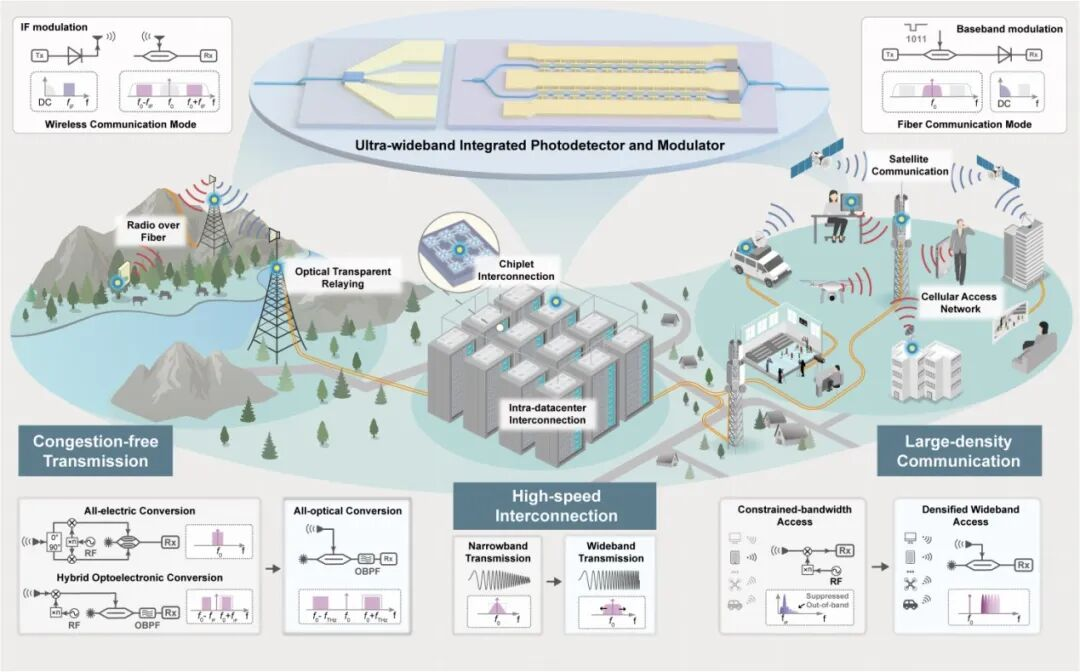
Figure 2.Conceptual diagram of all-optical ultra-broadband telecommunication interconnection system driven by integrated photonics.
To address the above issues, the research team proposed the concept of integrated “fibre–wireless converged communication” and achieved disruptive breakthroughs in both hardware devices and software algorithms. Based on an advanced thin-film lithium niobate photonic material platform and anoptimizeduni-traveling carrier photodiode structure, the team successfully realized a broadband flat EO-OE conversion link exceeding 250 GHz. This approach fundamentally circumvents the bandwidth limitations and noise accumulation of traditional electrical frequency-multiplying chains, providing >100 GHz of usable signal bandwidth in both wired and wireless frequency bands, meeting the needs of future ultra-high-speed wired and wireless communications. In addition, the team applied AI technology to channel equalization, proposing a novel neural-network-based digital signal processing algorithm that significantly enhances the system's resilience to nonlinear impairments and other disturbances, completely overcoming the fundamental challenge that traditional equalization algorithms face in handling complex channels.

Figure 3.Key performance characterization of ultra-wideband EO-OE integrated photonic chips.
The team's experimental verification shows that the system supports single-channel fibre communication rates exceeding 512 Gbps for intensity modulation direct detection (IMDD) and over 400 Gbps for opticallyassisted THz wireless communication, achieving world-leading performance and setting a new benchmark in all-optical communications. Notably, both the ultra-wideband integrated photonic devices and the AI equalization algorithm proposed by the team are compatible with both wired and wireless communications, serving as universal functional units to support dual-mode transmission, and for the first time bridging the gap between the two major communication domains at the physical layer.
Furthermore, the team simulated a 6G massive user access scenario, demonstrating multi-channel real-time 8K video access over 86 channels, with transmission bandwidth an order of magnitude higher than current 5G standards. Thanks to the ultra-wideband flat frequency response of the core devices, all channels exhibited high performance consistency, demonstrating the system's superior multi-user support capability. This breakthrough provides a novel solution for high-density exploitation of the terahertz spectrum resource in 6G communications.
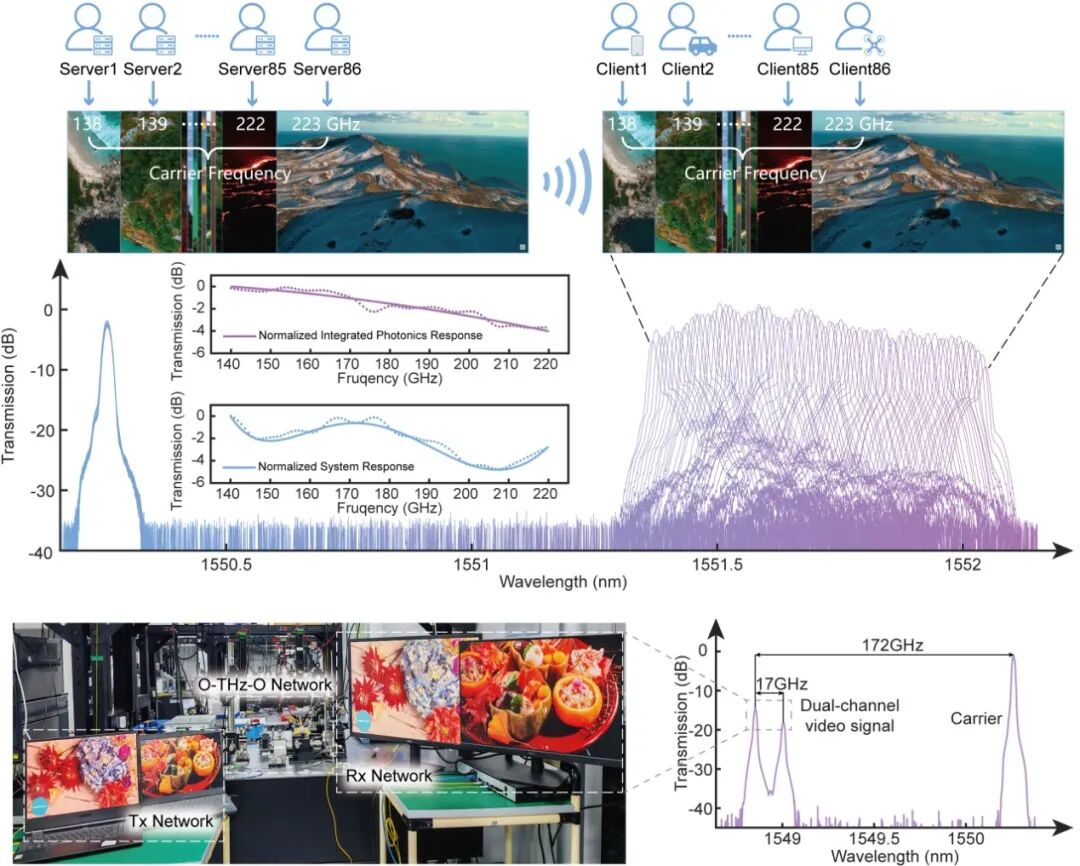
Figure 4.Results of multi-channel high-definition real-time video transmission.
In addition to achieving ultra-large capacity communication, the system demonstrates excellent performance in other key features such as energy efficiency, cost, and scalability for mass deployment, showing highly promising application prospects in scenarios like 6G base stations and wireless data centers. The all-optical architecture allows seamless integration with existing optical networks, promoting deep unification of mobile access networks and fibre backbone networks.
All threeNaturereviewers gave high praise to the paper, describing the experiments as “heroic and record-setting” and noting that “multiple world records have been achieved in this work”. They also stated that “it makes a significant contribution to the advancement of converged optical/THz communication systems”.
All key technologies and fabrications of this achievement are based on domestically developed integrated optical process platforms, without requiring traditional microelectronics advanced process technology, thereby helping China achieve a “lane-changing” overtaking in the semiconductor chip field. The research team expects this achievement to serve as a technological engine for the next-generation telecommunication revolution, driving collaborative innovation and breakthrough development across the entire industrial ecosystem, and achieving leapfrog development in information and communication technology from following, to running alongside, and finally to leading.
In the future, the research team will continue to focus on improving system integration, completely eliminating discrete components, exploring fully monolithic integration based on the thin-film lithium niobate platform, and ultimately realizing fully functional miniaturized transceiver modules from lasers to antennas. The team is also extending this achievement to fields such as THz radar, ultra-wideband real-time frequency measurement, THz spectroscopy, and imaging, providing a compact and economical solution for THz generation, modulation, and detection for related applications.
This research was supported by grants including the National Key Research and Development Program of China (Young Scientist Project), the Key Project, Major Research Instrument Development Project, Young Scientist Fund (Category B and C) of the National Natural Science Foundation of China, and the Major Research Project of Peng Cheng Laboratory.