ANews & Viewsarticle on PKP, co-authored by the team of Assistant Professor Lining Zhang and Academician Ru Huang, has recently been published online in SCIENCE CHINA Information Sciences (link1). The publication marks another important milestone for the team’s research in advanced technology modeling.
Compact device models and process design kits (PDKs) provide a critical interface between integrated-circuit (IC) design and manufacturing. In practice, electronic design automation (EDA) tools operate in close coordination with PDKs to enable circuit design and verification under a given technology node. To support teaching and researchinadvanced technologies, the community increasingly relies on predictive, pre-research virtual PDKs—such as the open-source ASAP7 released by ArizonaState University. Unlike foundry PDKs tied to specific manufacturing processes, predictive PDKs integrate key technology trends and projections to provide a foundational platform for forward-looking academic research.
To address thisneed, the Zhang–Huang team has developed aproprietary series of predictivedevice models and PDKs: PKP (Peking University Predictive PDK). The open-source predictive kit PKP3, targeting 3‑nm gate-all-around (GAA) nanosheet technology, has been released. PKP3 includes the team’s PHIMO family of compact models, parameterized cells (PCells) based on virtual design rules, standard-cell libraries, and SRAM cell designs. In addition, multiple process corners are defined for devices with different threshold-voltage options. Initiated by Assistant Professor Lining Zhang, PKP has been developed in collaboration with research groups from the National Key Laboratory of Micro/Nano Devices and Integrated Technology at Peking University. The PKP series will continue to be updated, with planned support for additional emerging technologies, including backside power delivery networks (BSPDN).
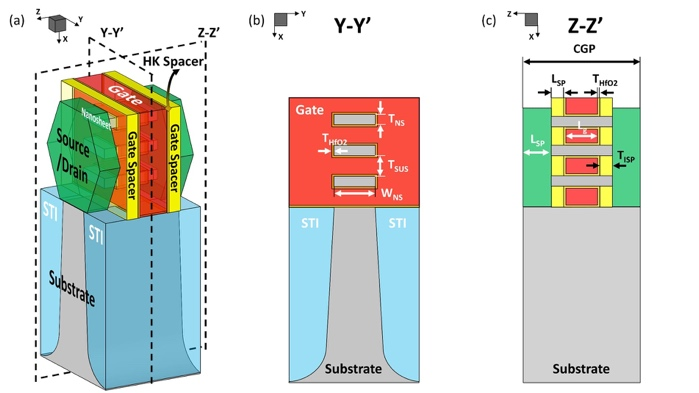
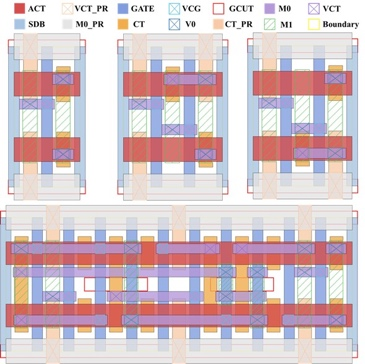
Figure 1: GAA nanosheet technology and standard cells designed using the PKP PDK
In recent years, the Zhang–Huang team has published a series of high-impact studies on compact modeling for GAA nanosheet devices, establishing an independentlydeveloped PHIMOcompactmodeling framework for GAA technologies. Nanosheet devices feature ultra-thin channels; under aggressive scaling, quantum confinement becomes significant, leading to energy-level quantization and step-like electrical characteristics distinct from those of conventional devices. At the same time, Joule heating grows more pronounced at nanoscale dimensions, elevating transistor temperature, while parasitic effects associated with the unique mid-of-line structure may slow response speed. These higher-order effects can materially affect device and circuit reliability and therefore must be accounted for in circuit design and technology development.
To address these challenges, the team has advanced physics-based core models and carried out systematic modeling research around them. The team proposed an accuratemodelingstrategy for quantum confinement effects, published inFundamental Research(link2).To addressthe distinctive thermal transient dynamics of GAA self-heating, the team developed a physics-based multi-order self-heating model capable of accurately capturing temperature response, published inIEEE Transactions on Electron Devices(TED) (link3). The team also introduced a parasitic-capacitance model based on conformal mapping to reproduce mid-of-line parasitic effects with high fidelity, also published inIEEE TED(link4). In addition, the team proposed an accelerated simulation methodology for circuit self-heating, achieving approximately a three-orders-of-magnitude speedup through techniques including dynamic time evolution and power-equivalence modeling; the related work was published inIEEE TED(link5). For BSPDN, the teamdevelopeddedicated parasitic-effect models to enable investigation of this emerging technology and comparative evaluation across technology options, with results also published inIEEE TED(link6).
In parallel, to address the increasing complexity of advanced process models and the growing difficulty of parameter extraction, the team proposed PHIMO‑NN, an innovative hybrid modeling approach that integrates physics and artificial intelligence. By leveraging a dual-driven framework, PHIMO‑NN enables model-order reduction and fast parameterization via neural-network training. This work was published inIEEE Transactions on Computer-Aided Design of Integrated Circuits & Systems(link7).
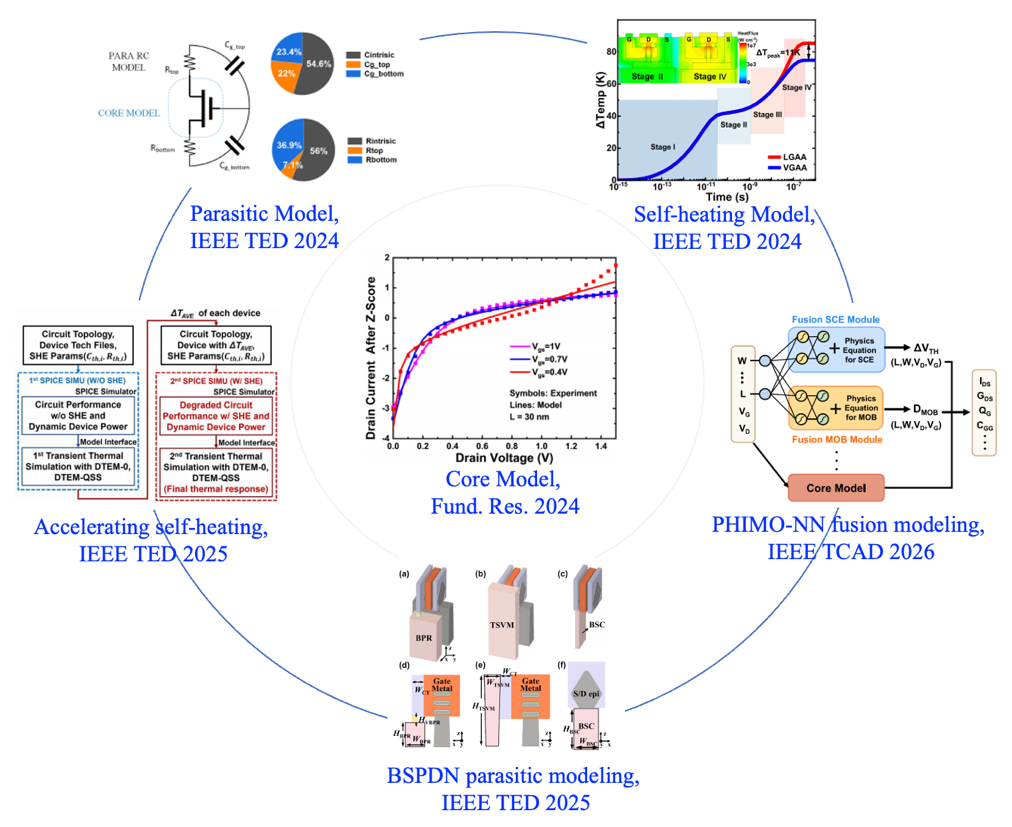
Figure 2: Representative publications by the team in advanced technology modeling in recent years
The team’s GAA compact model has been integrated into commercial circuit simulators developedin China andhas been applied in pathfinding designs at leading enterprises. As the core model engine within the PKP PDK, PHIMO further supports academic research and exploration of frontier technologies, contributing to innovation aimed at addressing critical “chokepoint” challenges in EDA and IC design. The PHIMO model series has also been applied in additional industrial and research scenarios, including support for TFET tape-outs for high-volume manufacturing lines at a leading foundry and the design of spiking neural-network circuits based on ferroelectric tunnel junctions. The team’s work in device modeling and machine-learning-enabled modeling methods has attracted growing international attention and recognition, including interest from major EDA companies such as Cadence and Synopsys.
LINK:
[1]https://www.sciengine.com/SCIS/doi/10.1007/s11432-025-4805-5
[2]https://www.sciencedirect.com/science/article/pii/S2667325823000286
[3]https://ieeexplore.ieee.org/abstract/document/10682596
[4]https://ieeexplore.ieee.org/abstract/document/10352103
[5]https://ieeexplore.ieee.org/abstract/document/11215685
[6]https://ieeexplore.ieee.org/abstract/document/11082524
[7]https://ieeexplore.ieee.org/abstract/document/11084862