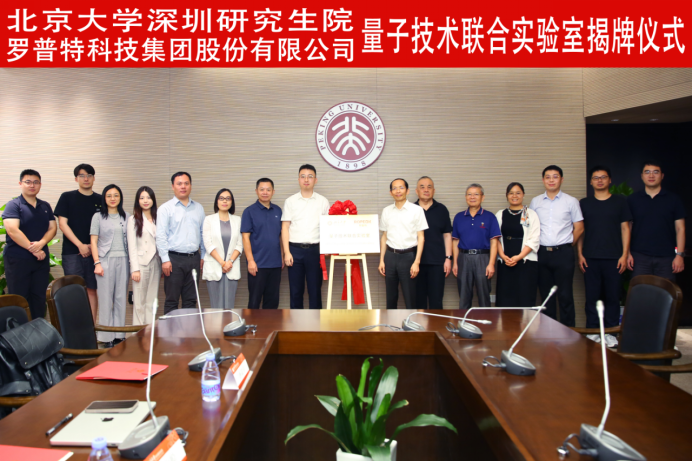
1. Signing ceremony
On 23 July 2026, Peking University Shenzhen Graduate School (PKU Shenzhen) and Ropeok Technology Group Co., Ltd. (ROPEOK) held a signing ceremony in Shenzhen to establish a joint laboratory for quantum technology.
Wang Tianbing, Vice Chancellor of PKU Shenzhen; Shi Lili, Director of the Office of Research Affairs at PKU Shenzhen; Yang Yuchao, Dean of the School of Electronic and Computer Engineering (SECE); Li Qian, Vice Dean of SECE; Su Yuqi, Assistant Professor (Researcher) at SECE and Director of the Joint Laboratory; and faculty representatives attended the ceremony.
Representing ROPEOK were Chen Yanxing, Chairman of the company; Wu Dong, Vice Chairman; Chen Shuili, Director; and other representatives. The participants gathered to witness the launch of the new industry–university research partnership.
Advancing Industry–University Research Collaboration
Wang Tianbing delivered the opening remarks, welcoming the representatives from ROPEOK and introducing the development of PKU Shenzhen. He expressed the hope that the University would draw on its strengths in scientific research and talent development, work closely with industry through the Joint Laboratory, and address real-world technological challenges and practical industry needs.
2. Wang Tianbing delivers the opening remarks.
Shi Lili reviewed PKU Shenzhen’s recent progress in the commercialisation and application of scientific and technological achievements. She noted that quantum technology is a strategically important field and expressed her expectations for the new partnership. By combining Peking University’s research strengths with ROPEOK’s technological capabilities and application scenarios, the Joint Laboratory is expected to accelerate the translation of research outcomes into practical applications.
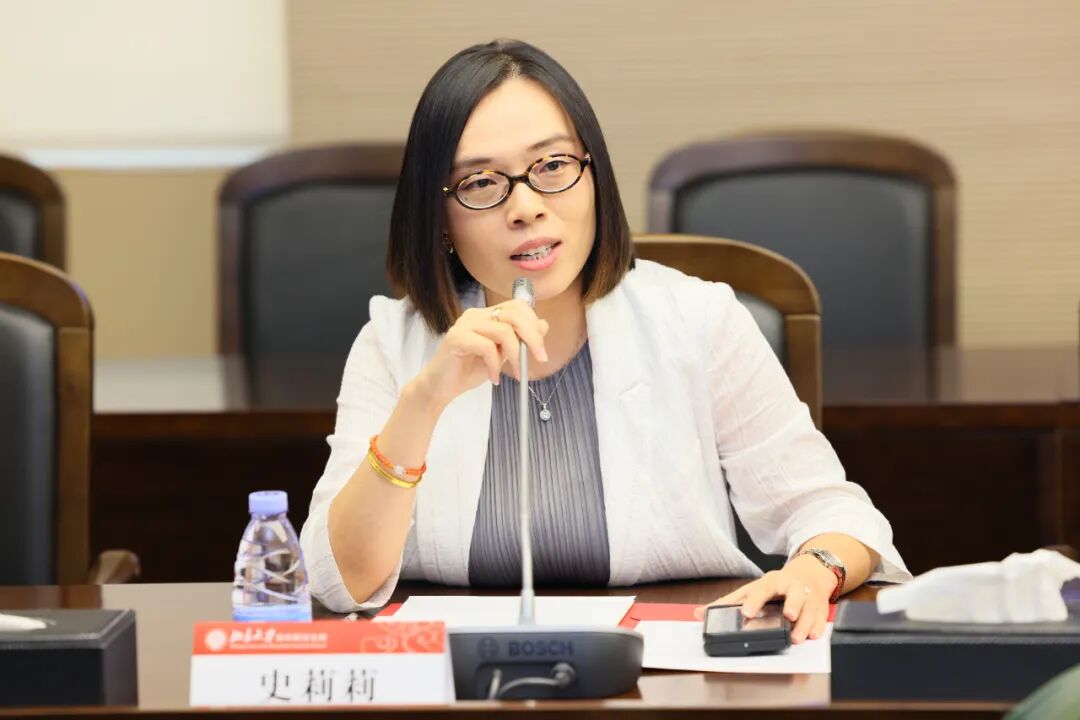
3. Shi Lili delivers remarks.
Yang Yuchao congratulated both parties on the establishment of the Joint Laboratory. He noted that SECE has developed strong research foundations in integrated circuits, artificial intelligence and embodied intelligence. He described the establishment of the Joint Laboratory as a new starting point for collaboration. The Laboratory, he said, should closely examine industry needs, address the key challenges facing specialised quantum and emerging computing paradigms in real-world applications, and establish a technology-transfer model in which industry defines the problems, universities develop the solutions, and the market evaluates the outcomes.
4. Yang Yuchao delivers remarks.
Chen Yanxing noted that ROPEOK, a listed artificial intelligence company on the STAR Market, has developed a range of application scenarios in the AI sector. Through the collaboration, the company will draw on the research and development strengths of PKU Shenzhen to advance its work in specialised computing fields and further expand its AI industry ecosystem.
5. Chen Yanxing delivers remarks.
Advancing the Application of CMOS Ising Machines
Su Yuqi introduced the research focus and development objectives of the Joint Laboratory. He explained that Ising computing is an emerging computing paradigm for solving combinatorial optimisation problems and has potential applications in fields including financial investment, biomedicine and artificial intelligence. As the scale of such problems increases, their computational complexity can grow exponentially, making it difficult to achieve efficient solutions simply by increasing conventional CPU or GPU resources. Ising computing provides an alternative approach for addressing large-scale optimisation problems and overcoming the limitations of conventional computing architectures.
6. Su Yuqi introduces the research focus of the Joint Laboratory.
Existing Ising-machine research has explored several technological routes, including quantum Ising machines based on superconducting qubits and optical Ising machines based on photonic devices or chips. The Joint Laboratory will focus on a CMOS-based Ising-machine architecture. By drawing on mature semiconductor manufacturing processes, this approach aims to support the lower-cost, scalable engineering and application of specialised computing systems. The team has previously developed a fully digital, computing-in-memory CMOS Ising machine. Related research has been published at leading integrated-circuit conferences and in journals, including ISSCC, the VLSI Symposium and IEEE Journal of Solid-State Circuits. The Joint Laboratory aims to establish a complete technical pathway spanning algorithm optimisation, architecture design and hardware implementation. Its research is expected to support computing-intensive applications such as AI inference acceleration, electronic design automation, travel-route planning and portfolio optimisation.
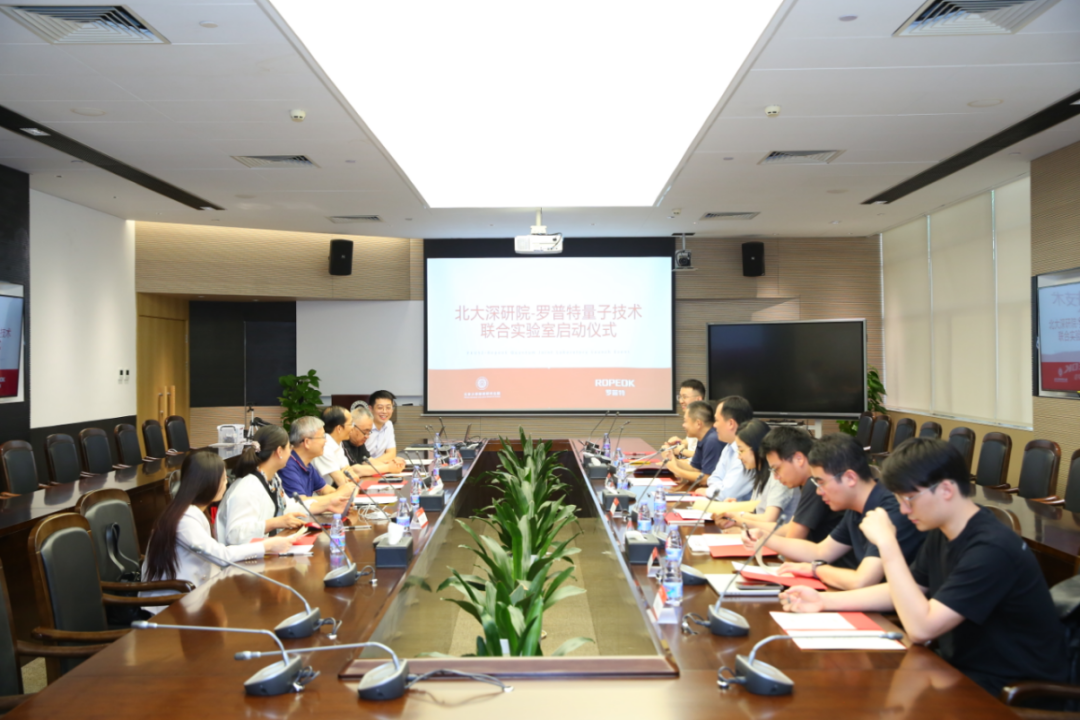
7. Group photo of the event
Signing and Unveiling the Joint Laboratory
Following the presentations, the two parties formally signed the cooperation agreement. Su Yuqi represented PKU Shenzhen, while Wu Dong represented ROPEOK at the signing. Representatives from both parties then jointly unveiled the plaque for the Joint Laboratory.
8. Representatives of both parties sign the cooperation agreement.
9. Wang Tianbing presents appointment certificates to members of the Joint Laboratory.
The establishment of the Joint Laboratory marks a new stage in industry–university research collaboration between PKU Shenzhen Graduate School and ROPEOK. It also represents an exploration of the application of the “AI Plus” initiative in the field of quantum technology. Looking ahead, the two parties will use the Joint Laboratory as a platform to advance research at the intersection of artificial intelligence and quantum technology and promote the development and application of emerging computing technologies.